
Fish species · Predator
Muskellunge: the fish of ten thousand casts
The muskellunge is the biggest predator in the northern lakes and one of the hardest fish to catch. It lives only in big lakes, follows lures without biting and needs heavy tackle when it finally does.
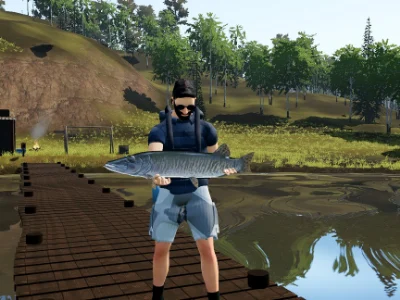
How to recognise a muskellunge
The muskellunge (Esox masquinongy), or muskie (also spelled musky), is a huge, long-bodied relative of the pike with a duck-bill jaw full of teeth and fins set far back near the tail. Its markings are dark bars or spots on a light, silvery-green to bronze body — the reverse of a pike's light spots. The tail lobes are pointed. Muskie commonly reach 5–10 kg, and the biggest grow far larger. Not sure which one you have? See pike vs muskie vs pickerel.
Where muskellunge live
Muskie need big water and plenty of food:
- Large lakes with a good supply of fish to eat.
- Weed edges, where they lie in ambush.
- Drop-offs, rocky points and sunken timber.
A lake holds far fewer muskie than pike, so each fish has a large home range.
When muskellunge feed
Muskie feed in short spells, most often around dawn and dusk, and on dull, windy days. A change in weather often switches them on.
Best baits for muskellunge
- Large crankbaits and jerkbaits, twitched and paused.
- Big bucktail spinners, retrieved steadily.
- Large soft plastics and big live baitfish.
How to catch muskellunge
- Fish the biggest lakes. No big water, no muskie.
- Work the weed edges. Cast parallel to the edge and along points.
- Twitch and pause. Erratic movement triggers a strike from a following fish.
- Use strong tackle. A wire or heavy leader stops the teeth cutting the line.
- Handle with care. Support the body, unhook quickly and return the fish fast.
Muskellunge in Survival Angler
- Found on
- Northwoods Lakes
- Where to look
- Weed beds, Drop-offs, Sunken timber & rock
- Depth
- 1–8 m (3–26 ft)
- Most active
- Dusk & Dawn
- Best baits
- Diving crankbait, Live minnows, Inline spinner
- Typical size
- 6 kg (13 lb)
- Trophy from
- 15 kg (33 lb)
- Float (bobber) bite
- Plunges — the float is pulled hard under in one go. Strike fast — the window is short.
- How it fights
- Long, powerful runs — let the drag work and keep the rod up.
Numbers come straight from the game’s fish data, so the page and the lake always agree.
In Survival Angler, muskellunge live only in the biggest Northwoods lakes — ten hectares and up — and they are among the rarest fish on the map. A diving crankbait twitched along the weed edge is the best way to find one, with live minnows and inline spinners next. The bite is a plunge — strike fast. Big muskie make long runs and can leap; you need a strong rod and a well-set drag. The lake legend known as the Loon Ghost is a muskellunge.
Frequently asked questions
How do you tell a muskie from a northern pike?
A pike has light, bean-shaped spots on a dark body; a muskie usually has dark spots or bars on a light body. Muskie tail lobes are more pointed, and the lower half of a muskie's cheek and gill cover has no scales, while a pike's cheek is fully scaled.
What is the best lure for muskie?
Big lures: large crankbaits, jerkbaits, bucktail spinners and big soft plastics. Twitching and pausing the lure, and finishing every cast with a figure-eight beside the boat, triggers following fish.
Why is the muskie called the fish of ten thousand casts?
Because muskie are scarce, wary and often follow a lure all the way in without biting. Even experienced anglers can fish for days between bites.