
Legend · Northwoods Lakes
The Loon Ghost, the pale muskie of Loon Lake
A pale muskie the length of a man drifts along the weed walls of the biggest lake in the Northwoods. Anglers call muskies the fish of ten thousand casts — this one may need a few more.
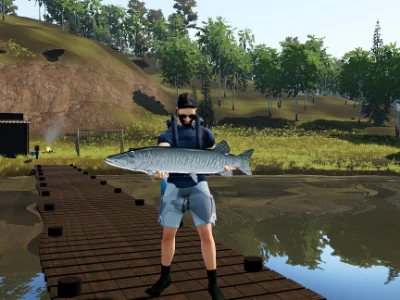
The Loon Ghost lives in Loon Lake, the largest water on the Northwoods map at about 30 hectares and up to 14 metres deep. It is the lake with the island — and the floating wooden bridge that lets you walk out to it without a boat.
The Loon Ghost at a glance
- Map
- Northwoods Lakes
- Lives in
- Loon Lake only
- Weight
- 18 kg (40 lb) to 28 kg (62 lb) · typically 21 kg (46 lb)
- Depth
- 1.5–9 m (5–30 ft)
- Where to look
- Drop-offs, Weed beds, Sunken timber & rock
- Feeds hardest
- Dawn & Dusk
- Best natural bait
- Live minnows
- Best lures
- Diving crankbait, Rubber frog · twitching
- Float bite
- Plunges
- How it fights
- Long, powerful runs — let the drag work and keep the rod up.
- Rod
- Heavy live-bait rod (holds 30 kg): 70% load with a typical fish
Heavy baitcaster (holds 30 kg): 70% load with a typical fish
Numbers come straight from the game’s fish data. Rod load above 100% means the fish is heavier than the rod is rated for — still possible, but every run and head-shake gets harder.
Where it hunts
The Ghost hunts like any muskellunge: it patrols edges. Its favourite water is the drop-off, then the outside of weed beds and sunken timber, anywhere from 1.5 to 9 metres down. It rarely comes into the shallows and does not cruise the open middle of the lake.
Loon Lake has a lot of edge. The deep shelf around the island is the obvious place to start: walk the floating bridge, stand at the island and cast along the line where the bottom falls away. With a boat you can work the far shore as well.
When to fish
Dawn and dusk are its hours. In the middle of the day it is close to switched off, and at night it is slow. The daily signs — big swirls in one spot of Loon Lake — appear at dawn. Find them and the Ghost takes a bait far more often for the rest of the day in this lake.
Lures and baits
The Ghost is the one legend that prefers a lure to anything else:
- Diving crankbait is its first choice. It floats at rest and dives to about 2.5 m when you reel — ideal for running along a weed wall.
- Twitching is the retrieve it likes best: short jerks and pauses. A stop-and-go retrieve is second.
- A popper, an inline spinner and a casting spoon all catch it too.
- On a float rod, a live minnow works almost as well as the crankbait.
The fight
On a float, a muskie bite is a plunge — the float is dragged straight under and the strike window is short. On a lure, the take is a sudden explosion on the surface and you have about a second to set the hook. After that, expect long, heavy runs. A typical Ghost of 21 kg is about 70% of what a heavy baitcaster is rated for, and more than any float rod can hold.
Why anglers chase it
Loon Lake is big and the Ghost is one fish in it, so most of the work is reading the water: the right edge, the right hour, the right lure. Catch it once and it goes into your journal and the trophy hall — and, if you are signed in, into your own home pond.