
Legend · Northwoods Lakes
Old Granite, the deep-water lake trout of Clearwater Lake
Fishermen talk of a grey trout as old as the cabins, holding over the deepest hole of Clearwater Lake. It is the one legend you cannot catch near the surface — you have to go down to it.
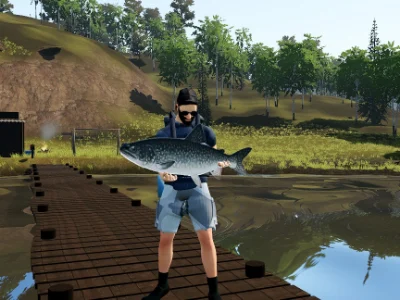
Old Granite lives in Clearwater Lake, the second-largest water in the Northwoods: about 18 hectares, up to 14 metres deep, with the dam and spillway of an old sawmill where the creek comes in.
Old Granite at a glance
- Map
- Northwoods Lakes
- Lives in
- Clearwater Lake only
- Weight
- 14 kg (31 lb) to 24 kg (53 lb) · typically 17 kg (37 lb)
- Depth
- 9–14 m (30–46 ft)
- Where to look
- Deep basin, Drop-offs
- Feeds hardest
- Dawn & Daytime
- Best natural bait
- Live minnows
- Best lures
- Casting spoon, Soft-plastic jig · hopping along the bottom
- Float bite
- Plunges
- How it fights
- Dives for the bottom — lift and gain line between dives.
- Rod
- Heavy live-bait rod (holds 30 kg): 57% load with a typical fish
Heavy baitcaster (holds 30 kg): 57% load with a typical fish
Numbers come straight from the game’s fish data. Rod load above 100% means the fish is heavier than the rod is rated for — still possible, but every run and head-shake gets harder.
Fishing deep
Old Granite is a true deep-water fish, like any big lake trout. It holds between 9 and 14 metres — the deepest water on the map — over the deep basin first and the steep drop-offs second. It almost never comes into weed or shallows.
That changes how you fish:
- On a lure rod, use something that sinks. A casting spoon is its favourite: cast it out, let it count down to the bottom, then bring it back with pauses. A soft-plastic jig is nearly as good — let it touch bottom and hop it back in short lifts. Hopping along the bottom is the retrieve it likes best.
- On a float rod, a live minnow works, but you need the float set very deep so the bait reaches the trout's level.
- A fish finder saves a lot of time: find the deepest readings in Clearwater and fish there.
A boat helps too. The deep hole is a long cast from most of the bank, and from a boat you can sit right over it.
When it feeds
Old Granite is the most forgiving legend about the clock. It feeds best at dawn, but it stays active through the day as well — cold, deep water does not care much about the midday sun. Only at night does it slow right down. Its daily signs, the big boils on the surface, appear at dawn.
The fight
On a float, a lake trout bite is a plunge — straight under, strike fast. Once hooked, Old Granite does not run across the lake like a pike. It dives: heavy, stubborn pulls straight back down to the bottom. Lift, gain line while it pauses, and let the drag work when it dives again. It has plenty of stamina, so expect a long fight.
A typical Old Granite of 17 kg is a little over half of what the heavy baitcaster is rated for, and close to the limit of the carbon feeder rod.
Worth the trip
Lake trout grow slowly in cold, deep water, so a fish over 20 kg would be a very old fish. Land it once and it goes in your journal and trophy hall. If you are signed in you can bring it home to your own pond — or let it go back to the deep for a big reputation reward.