
How the simulation works
A realistic fishing simulator, and how it works under the water
Anyone can call a fishing game realistic. Here is what Survival Angler actually calculates between your cast and the fish in your hands, so you can judge for yourself.
Where the fish are
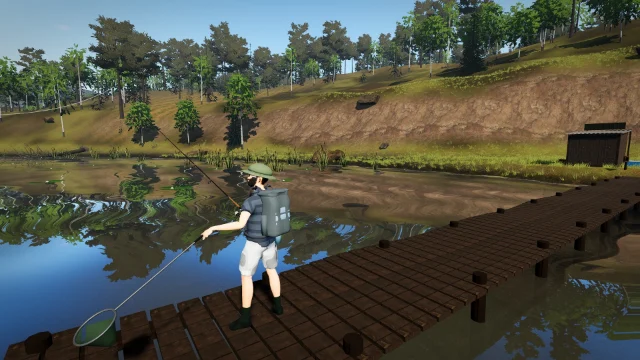
Each lake has real depth and real cover: weed beds, drop-offs, sunken timber, open water, deep basins, creek mouths and shallows. Each species rates those places differently and keeps to its own depth range. In the game's data a northern pike rates a weed bed three times as highly as open water. A lake trout wants the deep basin. A brook trout hardly leaves the creek mouths.
On top of that, every spot has its own stock. Fish it hard and it goes quiet until it recovers, for you and for everyone else. Bites are decided on the server from the same map you see, so reading the water is the skill that matters.
When they feed
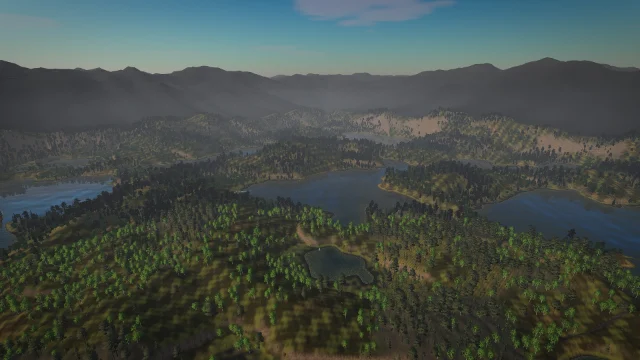
Every species has four activity numbers, for dawn, day, dusk and night. Burbot do not feed at all in full daylight and peak after dark. Perch do the opposite. Pike peak at dawn and dusk. The best time to go fishing guide uses the same numbers.
Weather changes the day as well. Cloud, rain, fog and thunderstorms come and go, and lightning is a reason to get off the water.
What they take
There are natural baits (worms, nightcrawlers, sweetcorn, boilies, minnows, crawfish) and lures that run at different depths: poppers and frogs on top, spinners and spoons below, then crankbaits and jigs. Fish also care how you move a lure. A muskie prefers a twitched crankbait. A walleye or zander would rather see a jig hop along the bottom. Wind at one speed and you will catch something, but not everything.
How they bite
On a float, or bobber, five different bites tell you what is down there:
| Bite | What the float does | Typical fish |
|---|---|---|
| Dip | Bobs, then goes under | Perch, bluegill, black crappie |
| Lift | Rises and lies flat | Bream, tench, white crappie |
| Slide | Glides away | Carp, catfish |
| Plunge | Dragged straight under | Pike, bass, bowfin |
| Tremble | Shivers, then sinks slowly | Walleye, burbot, whitefish |
Nibbles come first. Strike on a nibble and you pull the hook out of an empty mouth.
How they fight
Pike, carp and the big catfish run. Lake trout, walleye and burbot dive. Bass and rainbow trout jump. Crappie, bream and bowfin thrash close in. Against that you have the rod's bend, the line's breaking strain and the drag, and all three have numbers. The starter float rod is rated for fish to 4 kg (9 lb). The heavy baitcaster is rated for 30 kg (66 lb). Hook something too big for your rod and you may still land it, but every run gets harder to hold.
You can hear the fight too: the drag screams, a tight line hums, and just before the line parts it crackles.
What we changed for play
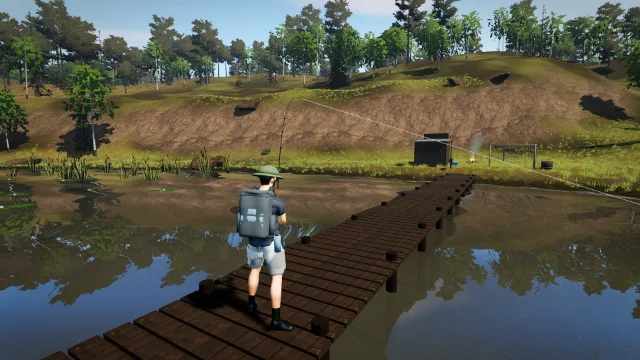
A real day on the water has long quiet hours, and nobody wants all of them. In the game:
- a day lasts 48 real minutes, so dawn and dusk come round often
- you wait minutes for a bite, not hours
- beginners get a first fish quickly and a little help in their first fights
- rods and lures wear out, but nobody has to untangle a bird's nest
Everything else is meant to work the way it does on a lake. If you find a place where it does not, tell us.
Open world, and a night to get through
The simulator sits inside an open world. You have to eat, drink, stay warm and get home, or pitch a tent and fish until sunrise. Three maps are open so far, the Northwoods Lakes, the Southern Bayou and the frozen Frostbound Lakes, and you can fish them alone or with friends.
It runs on any PC and on phones and tablets. For a quick overview and a comparison with other fishing games, see the free online fishing game page.
Frequently asked questions
How realistic is the fishing?
Where fish are, when they feed, what they take, how they bite and how they fight all differ by species and follow real habits. Some things are sped up for play: a full day passes in 48 minutes, and you wait minutes for a bite, not hours.
Is it an open world fishing game?
Yes. Both maps are open from shore to shore. You walk, wade, ride or drive to any lake on the map, with no loading between them.
Do I need to know how to fish?
No. The game teaches the basics in the first few minutes and your first fish comes quickly. Real knowledge pays off later, when you look for a particular species or a trophy.
Is the fishing simulator free to play online?
Yes. The browser version is free, with no loot boxes or paid items. Rods, bait and boats are bought with in-game money you earn by selling fish.