
Map 3 · Free · Hard
Frostbound Lakes: ice fishing on a frozen map
Fifteen lakes frozen solid under snow, a plowed ice road, a village of fishing shacks — and cold that is a danger of its own. The Frostbound Lakes is the third map in Survival Angler, built entirely around ice fishing.
How to get there
The Frostbound Lakes is free and open to everyone during Early Access — no unlock needed. Go ice fishing now or pick it on the start screen. It is a hard map: thin ice, hard cold and wolves, so dress warm and read the ice. Your money, gear, journal and angler level come with you between maps.
A frozen map
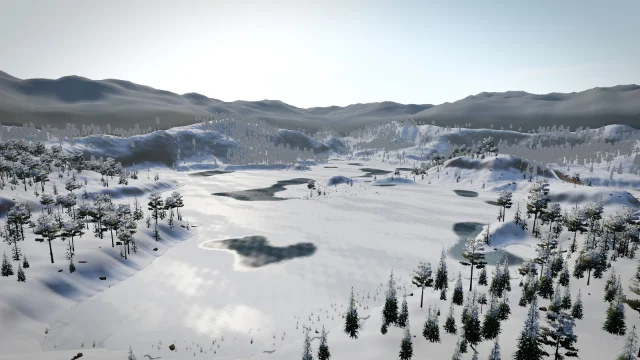
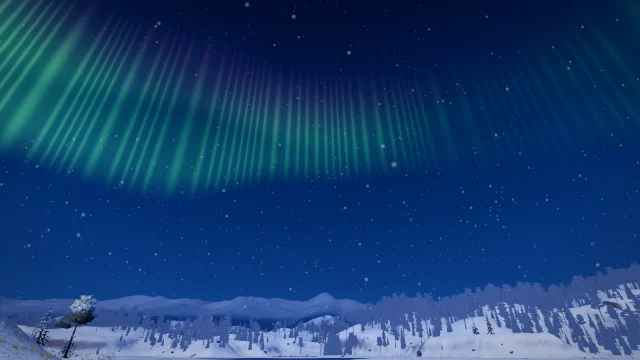
Fifteen lakes and ponds sit in snowy hills and frozen forest. Every lake is covered in ice, usually 30–48 cm thick — you walk, and drive, on the lakes themselves. It never rains here: overcast days bring snow, and on about half of the clear nights the northern lights ripple across the sky.
Read the ice before you walk on it. White, snowy ice is thick. Clear black patches are young ice, still safe on foot. Grey, wet, cracked ice around creek mouths and around the open water of springs in the middle of some lakes is thin — and you will hear it crack under your boots before it gives way.
Fishing through the ice
- Drill a hole. Buy a hand ice auger at a trading post, stand on the ice and press E. It takes a few seconds of cranking. Holes slowly freeze over again after a few hours.
- Fish straight down. Cast next to a hole and the bait drops into it. On a float rod the float sits in the hole; on a lure rod you jig straight up and down — lift, drop, pause.
- Ice rods. Short ice float and ice jigging rods are sold only on this map. They are light and sensitive — big fish need your heavier rods.
- The flasher. With a fish finder, a round flasher shows the water column under your hole: the bottom, your lure, and fish rising toward it.
- Hole size matters. A fresh hole lets through fish up to about 6 kg. Bigger fish stick in it — hold E to widen the hole before they shake free.
- Tip-ups. Set a few tip-ups with live minnows over their own holes. When a fish takes the bait, an orange flag springs up — run over and pull the line in by hand before the fish drops the bait.
The fish
The ice holds 22 regular species and 3 legends. Ten will be familiar from the Northwoods — pike, walleye, lake trout, whitefish, burbot, perch and others — and twelve live only here:
- Perch family: yellow perch, sauger
- Open-water schools: cisco, kokanee, rainbow smelt
- Trout, char and salmon: arctic char, splake, tiger trout, landlocked salmon, arctic grayling
- Giants: sheefish, lake sturgeon
The legends are Glacier King, a lake trout in Northern Light Lake; The Lantern, an arctic char that only feeds at night in Trapper Lake; and Old Plate, a giant sturgeon right under the camp in Snowshoe Lake. Fish that live only on the ice sell for more at the trading post.
Places on the ice
- The plowed ice road runs from the camp dock straight out over Snowshoe Lake, lined with orange-topped marker poles. Between the poles the ice is always thick enough for a truck.
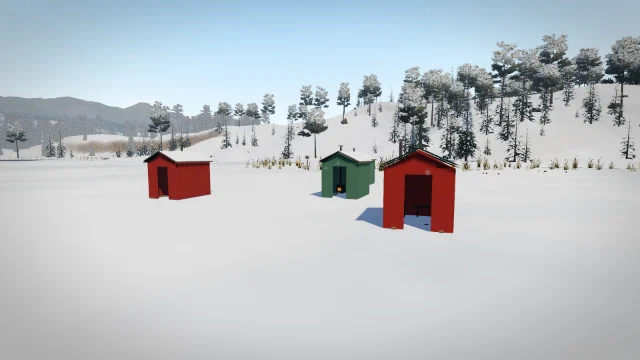
- The ice-fishing village on Moose Narrows: a few small shacks out on the ice, each with a stove and a hole already drilled that never freezes.
- The permanent fish house on Kettle Ice Lake, over the deepest water, with two holes and a stove.
- The warming hut on the shore of Frostbite Lake: a log cabin with a stove and benches.
Inside any of them you are out of the wind and warming up as if by a fire.
The cold
Cold is the main danger here. Your warmth only holds at about half by day and drops much lower at night, and wind across the open ice makes it worse. Below that, your hands go numb and reeling slows down. The insulated ice suit keeps most of the wind out. Stay near fires, huts and your own gear:
- A pop-up ice shanty with a small heater can be set up on solid ice anywhere: drill your holes inside it and fish out of the wind.
- Ice picks around your neck. If the ice gives way, you have ten seconds to claw your way out — with picks you always make it, without them your hands slip on the wet edge. Climb out soaked and you must reach a fire or a heater before the cold gets you.
Getting around
Boats stay in storage — the lakes are frozen. Your van can drive on the ice, but it needs at least 25 cm of it: in practice, the plowed road. The motorbike needs 15 cm. On ice everything slides: braking takes longer and the tail swings out in turns. Too-thin ice groans under the wheels as a warning — and then it breaks, the vehicle is towed back to storage for a fee and you are in the water.
The snowmobile, sold only here, is the fastest way across snow and ice, light enough for 15 cm of ice and far more sure-footed than wheels.
Wildlife
Wolves roam the frozen forest. At night, if you stand alone on the ice far from a fire, a pack will circle in and try to steal the biggest fish from your keepnet. Sprint straight at them and they scatter; grab back at the fish and you may get bitten. Bald eagles soar over the lakes and will swoop on a small fish you release onto the ice.